
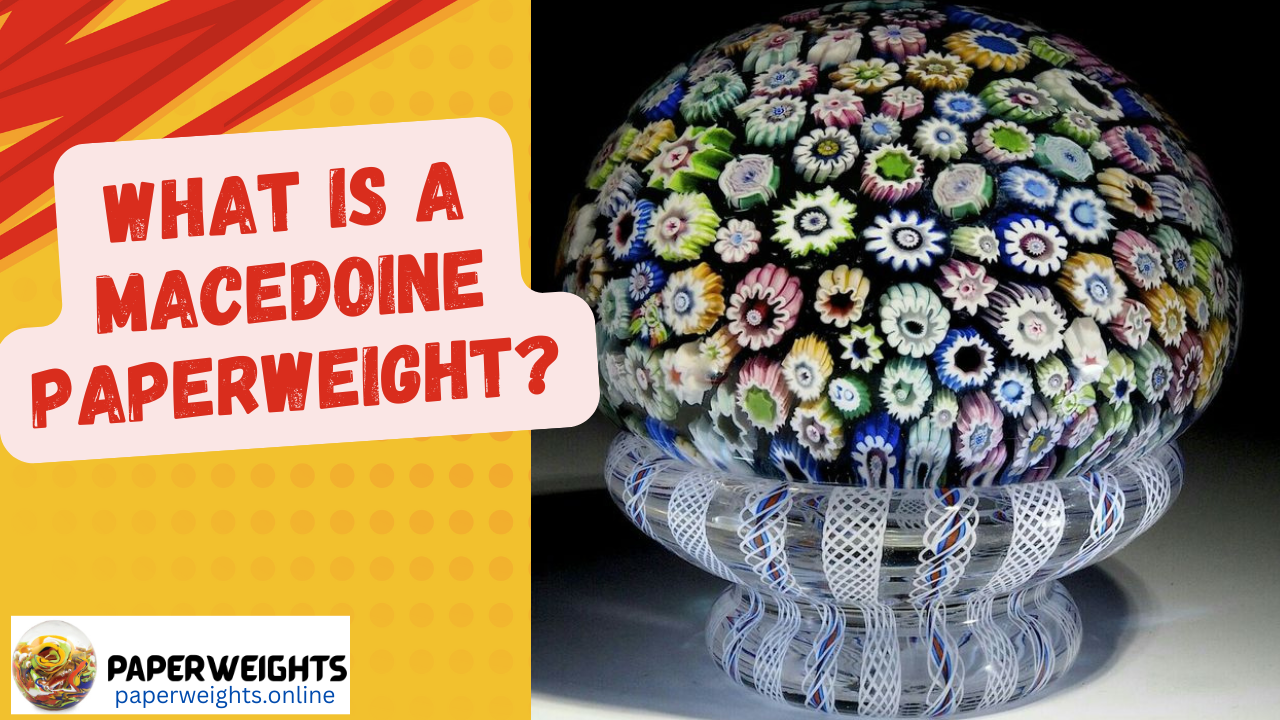
Okay, let’s explore another super interesting niche within the world of antique glass paperweights – the ones called “macedoine.” It’s kind of a funny name, right? It sounds more like something you’d find in a fruit salad than sitting on a desk! But these paperweights have a unique look and a cool story behind them. So, What is a macedoine paperweight? And how does it fit into the bigger picture, especially compared to those super organized millefiori or intricate lampwork pieces?
If you’re picturing perfect patterns or tiny sculptures inside the glass, think again! Macedoines are a whole different vibe. Understanding What is a macedoine paperweight? takes us back to the bustling glass factories of the 19th century and shows us a fascinating example of artistry meeting practicality, sometimes even accidentally! Let’s chop up this topic (pun intended!) and see what makes these “fruit salad” paperweights special.
First Glance: What Does a Macedoine Look Like?
Imagine you took a bunch of different kinds of colorful, chopped-up hard candy, maybe some twists, some patterned bits, some plain chunks, tossed them together like confetti, and then somehow froze them inside a clear glass ball. That’s kind of the visual you get with a macedoine paperweight!
Key features usually include:
- A Jumbled Mix: The defining characteristic is a random assortment of colorful glass elements seemingly scattered haphazardly within the clear glass dome.
- Variety of Bits: These elements aren’t usually uniform. You’ll often see:
- Fragments of Millefiori Canes: Broken or partial slices of those patterned rods we talked about in millefiori. Maybe just a petal section, or a distorted center.
- Bits of Latticinio: Short lengths or twists of that white (or colored) lacy-looking glass cane.
- Filigree Elements: Pieces of twisted colored glass ribbons or rods.
- Sometimes Whole Canes: Occasionally, you might see a few intact (but randomly placed) millefiori or simple patterned cane sections mixed in.
- Odd Shapes & Chunks: Sometimes just colorful bits of plain glass chips.
- Lack of Deliberate Pattern: Unlike millefiori paperweights where the slices are meticulously arranged (like in concentric circles or packed carpets), macedoines look chaotic and unplanned. The pieces might be lying flat, on their sides, tilted – it’s a jumble.
- Colorful Chaos: Because they use odds and ends, they are often very colorful, but the colors are mixed randomly rather than arranged in a specific color scheme.
Think “beautiful mess” rather than “perfectly ordered garden.” It’s a delightful explosion of random glass fragments suspended in time.
The Name Game: Why “Macedoine”?
This is where the fruit salad connection comes in! The term “macedoine” in French cooking refers to a dish made of a mixture of various fruits or vegetables cut into small pieces. Think of a classic fruit salad with bits of melon, berries, grapes, maybe some kiwi – all different colors, shapes, and sizes mixed together.
Glass collectors and historians borrowed this culinary term because it perfectly described the appearance of these paperweights – a colorful, jumbled mixture of diverse glass elements. Just like the fruit salad contains a random assortment of ingredients, the macedoine paperweight contains a random assortment of glass cane fragments and twists. The name captures that “mixed bag” quality beautifully.
The Ingredients: Where Did All Those Bits Come From?
So, if they weren’t planning these intricate patterns, where did the glass artists get all those random, colorful pieces that ended up inside a macedoine? The answer is often linked to efficiency and avoiding waste, which adds another layer to their story. What is a macedoine paperweight? It’s often a testament to the thriftiness (or perhaps just the reality) of a busy glass workshop!
The common theory and understanding is that the elements inside a macedoine are primarily:
- Leftovers and Scraps: Glassmaking, especially creating complex millefiori or latticinio canes, inevitably produces waste. Canes break during pulling or cutting, end pieces might be imperfect, or slices might not come out right. Instead of just discarding these potentially expensive colored glass fragments, thrifty glassworkers could collect them.
- “End-of-Day” Glass: A romantic notion suggests that at the end of a long workday, glassblowers might gather up all the leftover usable bits and pieces of colored glass from various projects and quickly incorporate them into these less formal paperweights. This used up valuable materials and maybe allowed apprentices to practice the encasing process without using prime, perfect canes.
- Intentional Fragments?: While the “end-of-day” scrap idea is popular, some experts believe that many macedoines were likely made more intentionally. Workers might have deliberately broken up sections of canes (perhaps imperfect ones) specifically to create the jumbled mixture for this style of paperweight, which could be produced more quickly than meticulously arranging perfect millefiori slices.
Whether purely accidental scraps or semi-intentional fragments, the key is that the internal elements are bits and pieces of other, more complex glasswork, tossed together rather than precisely placed.
How Are They Made? The Process Behind the Chaos
Even though the inside looks random, making a macedoine paperweight still requires skill, especially in encasing the elements smoothly in clear glass. The basic process would likely follow these steps:
- Gathering the Goods: The glassworker collects a variety of glass fragments – broken millefiori bits, sections of latticinio twists, maybe some plain colored chips. These are the “ingredients” for the macedoine.
- The Setup (Less Precise!): Unlike the painstaking arrangement needed for patterned millefiori, setting up a macedoine might be simpler:
- The fragments could be loosely arranged (or maybe even just gently tossed!) onto a flat marver (a steel table used for shaping glass) or into a shallow mold. There’s no need for perfect alignment or symmetry.
- Alternatively, a gather of clear molten glass could be rolled over the scattered fragments on the marver to pick them up.
- Encasing in Clear Glass: This step is crucial and similar to other paperweight techniques:
- A gather of molten clear glass is carefully brought down onto the jumbled fragments (or the gather with fragments already stuck to it is used).
- More layers of clear glass are gathered over the top, fully embedding the colorful bits inside. The glassworker shapes this outer layer into the desired dome or sphere, ensuring the fragments stay suspended within. Care must be taken to avoid trapping large air bubbles.
- Finishing and Annealing: The base is finished (often with a pontil mark left behind on older pieces), and then the entire paperweight undergoes the critical annealing process – cooling down very slowly in an oven to prevent stress cracks and ensure stability.
While the arrangement is random, the encasement and annealing steps still require the same level of skill as other high-quality paperweights to achieve a clear, smooth, and durable final product.
Let’s imagine Pierre, a (fictional) apprentice at the Clichy factory in 1850. He’s been watching the master artisans create perfect millefiori canes all day. At the end of the day, there’s a small pile of broken cane pieces and imperfect slices swept into a corner. The foreman tells Pierre, “Don’t waste those! Make some macedoines. Good practice for your encasing.” Pierre gathers the colorful scraps, arranges them loosely in a small mold, and carefully practices gathering clear glass over them, trying to get a smooth dome without too many bubbles. The resulting paperweight isn’t perfectly patterned, but it’s a vibrant, interesting object made from materials that might otherwise have been discarded.
Historical Context: When Were Macedoines Popular?
Macedoine paperweights emerged during the same Classic Period (mid-19th century, ~1845-1860) as the highly prized millefiori and lampwork styles. The famous French factories (Baccarat, Clichy, Saint Louis) and American ones (Sandwich, New England Glass Co.) that were mastering those intricate techniques also produced macedoines.
- Why Then? It makes sense that they appeared alongside the more complex styles. The production of intricate canes created the scrap fragments needed for macedoines. They offered a way to utilize expensive colored glass scraps effectively. They might also have been quicker to produce, potentially serving a slightly less expensive market segment or allowing for workshop practice.
- Less Common than Millefiori: While examples exist from all the major factories, macedoines are generally considered less common than the meticulously patterned millefiori paperweights from the same era.
Macedoine vs. The Competition: How Do They Stack Up?
What is a macedoine paperweight? It’s best understood by comparing it to its cousins:
| Feature | Macedoine Paperweight | Millefiori (Close Packed/Concentric) | Lampwork Paperweight |
| Internal Items | Random Fragments (cane bits, twists) | Whole, Perfect Murrine Slices | 3D Sculpted Glass Figure(s) |
| Arrangement | Chaotic / Jumbled / Random | Orderly / Patterned / Precise | Figurative / Scene-Based |
| Complexity | Lower (in arrangement) | High (in arrangement & cane making) | High (in sculpting skill) |
| Primary Appeal | Colorful Chaos, Texture, History | Intricate Patterns, Color Harmony | Realism/Artistry of Sculpture |
| Origin of Bits | Often Leftovers/Scraps | Purpose-Made Perfect Slices | Purpose-Made Sculpted Element |
Macedoines offer a unique aesthetic – less formal, perhaps more spontaneous-looking than their meticulously arranged counterparts.
Spotting a Macedoine in the Wild
Think you might have found a macedoine paperweight? Look for these signs:
- Random Mix: Does the inside look like a jumble of different colorful glass bits?
- Fragmented Elements: Can you see pieces that look like parts of millefiori canes or twisted ribbons, rather than perfect whole slices?
- Lack of Order: Are the pieces scattered haphazardly, tilted at different angles, without a clear geometric pattern?
- Variety of Colors/Shapes: Is there a mix of different types of glass elements (canes, twists, maybe chunks)?
If it looks like beautiful, colorful confetti trapped in glass, chances are good you’re looking at a macedoine!
Are They Valuable? Collectibility Notes
The value of antique macedoine paperweights can vary quite a bit.
- Historically Less Prized: Traditionally, collectors often valued the perfectly executed, complex patterns of millefiori or the detailed realism of lampwork more than the seemingly random jumble of macedoines. They were sometimes seen as “lesser” items made from scraps.
- Growing Appreciation: However, many collectors today appreciate macedoines for their own unique charm, their historical connection to the glassmaking process (representing workshop thrift), and the sheer chaotic beauty they offer. Each one is truly unique!
- Factors Influencing Value: As with all antique paperweights, value depends on:
- Maker: A macedoine attributed to a major factory like Clichy or Baccarat will likely be more valuable.
- Quality of Elements: Does it contain interesting or rare cane fragments? Is the color vibrant?
- Condition: Clarity of the glass, absence of chips or large scratches are crucial.
- Density & Arrangement: Some macedoines are more densely packed or have a more visually appealing random distribution than others.
While perhaps not reaching the absolute peak prices of the rarest millefiori masterpieces, good quality antique macedoines are definitely collectible and hold historical interest.
The Beauty in the Bits and Pieces
So, What is a macedoine paperweight? It’s a type of glass paperweight, popular during the mid-19th century Classic Period, characterized by a random, jumbled assortment of colorful glass fragments – often bits of millefiori canes, latticinio twists, and other elements – encased in clear glass.
Named after the mixed fruit/vegetable salad for its diverse and chaotic appearance, the macedoine often represents the clever use of leftover scraps from the creation of more intricate glass pieces. While perhaps less formally structured than its millefiori and lampwork siblings, the macedoine paperweight possesses a unique, vibrant charm and offers a fascinating glimpse into the practical realities and resourceful artistry of historical glassmaking. They are proof that beauty can definitely be found in the bits and pieces!
Macedoine Musings? FAQ Time!
Q1: Are macedoine paperweights just made of junk glass?
A: Not “junk” in the sense of low quality! The fragments inside are often pieces of the same high-quality, colorful glass canes used to make expensive millefiori or latticinio work. They are “scraps” or “leftovers” from that process, meaning the glass itself is often quite good, just broken or imperfect pieces used in a random way.
Q2: Is every paperweight with random stuff inside a macedoine?
A: Generally, yes, if the random stuff consists primarily of fragments of glass canes, twists, and chips from the glassworking process, jumbled together. If it contains things like glitter, random non-glass objects, or very crude chunks without clear relation to cane work, it might just be considered a less specific type of “frit” or “end-of-day” paperweight. Macedoine usually implies identifiable (though broken) elements from more complex glass techniques.
Q3: How can I tell a macedoine from a poorly made millefiori paperweight?
A: A poorly made millefiori might have crooked or unevenly spaced whole murrine slices. A macedoine typically features broken fragments and a much more random, tossed-together look with pieces lying at different angles, not just imperfectly arranged whole slices. The intent in millefiori is order (even if flawed); the look of macedoine is chaos.
Q4: Are macedoine paperweights rare?
A: They are generally considered less common than high-production millefiori patterns from the same period, but not usually among the rarest types of antique paperweights overall. Finding well-preserved examples, especially attributed to major factories, can still be challenging and rewarding for collectors.
Q5: Why would someone collect macedoines if they’re made of scraps?
A: Several reasons!
- Unique Beauty: Every macedoine is one-of-a-kind due to the random mix.
- Historical Interest: They tell a story about the glassmaking process and workshop economy.
- Affordability (Sometimes): They can sometimes be acquired for less than top-tier millefiori examples.
- Visual Appeal: Many people simply love the vibrant, chaotic energy they possess!
People Also Ask
How to Tell a Good Paperweight
We’ve all seen them – those little decorative lumps sitting on desks, sometimes looking a bit lonely, other times catching our eye with a surprising sparkle or an intriguing design. But how to tell a good paperweight from one that’s just… well, a lump? Is it just about whether it holds your papers down, or is there more to it?
Absolutely there’s more! A “good” paperweight can mean different things to different people, of course. But whether you’re looking for a reliable desk buddy, a charming decorative piece, or even a potential collectible, there are some key qualities that generally separate the truly good ones from the merely okay.
First Things First: What’s Its Job? (Functionality Matters)
Let’s start with the basics. A paperweight, at its core, has a job to do.
- Does it Have Enough Heft? A good paperweight needs to have sufficient weight to actually keep a stack of papers from taking flight in a breeze. A super lightweight, though pretty, object might fail at its primary mission. Pick it up – does it feel substantial enough for your needs?
- A Stable Base: It should sit flat and securely without wobbling or easily tipping over. A smooth, well-finished base is a good sign.
- Comfortable to Handle (If You Handle It!): While not always crucial, if you plan to pick it up often, it should feel reasonably comfortable in your hand, without overly sharp or awkward edges (unless that’s part of a very specific artistic design).
Beyond the Basics: What Elevates a Paperweight to “Good” (Or Even “Great”!)
Once it passes the “does it actually work?” test, other qualities come into play.
1. Quality of Materials & Construction: Is it Well Made?
This is a big one.
- For Glass Paperweights:
- Clarity & Brilliance: Is the glass clear and bright, allowing you to see any internal designs sharply? High-quality glass or crystal will have a lovely luminosity. Avoid pieces that look cloudy, dull, or have lots of distracting, unintentional flaws.
- Smooth Finish: The surface of the dome should be smooth and well-polished, free from obvious pits or rough spots (unless it’s an intentional texture).
- For Metal Paperweights:
- Solid Feel: It should feel solid, not hollow or flimsy (unless it’s a very specific lightweight design).
- Good Finish: Whether it’s polished, brushed, or patinated, the finish should be even and well-executed. Look out for rough casting marks or poorly finished edges on lower-quality pieces.
- For Stone Paperweights:
- Natural Beauty: The stone should be attractive, with interesting patterns or colors. It should be well-polished (unless a rustic finish is intended) to bring out its best qualities.
- No Major Cracks or Flaws: Check for significant cracks or unstable areas.
2. Artistry & Design: Does It Catch Your Eye (In a Good Way)?
A good paperweight often has an aesthetic appeal that goes beyond pure function.
- Skillful Execution (for decorative elements):
- If it’s a glass paperweight with internal designs (like millefiori or lampwork), are the elements well-defined, intricate, and skillfully made? Or do they look a bit messy or simplistic? Renowned makers like those featured in collections at The Corning Museum of Glass demonstrate exceptional skill.
- If it’s a figural paperweight (an animal, a shape), is it well-proportioned and nicely detailed?
- Pleasing Composition & Balance: Does the overall design feel harmonious and well-balanced? Or is it a bit awkward or cluttered?
- Originality & Uniqueness: Does it have a unique style or a particularly creative design that makes it stand out?
3. Condition (Especially for Older or Collectible Pieces)
If you’re looking at vintage, antique, or collectible paperweights, condition is paramount.
- Minimal Damage: Look for chips, cracks, deep scratches, or significant wear. While some gentle “shelf wear” on the base of an old piece is normal, major damage will detract from its quality and value.
- Clarity (for Glass): Ensure the glass isn’t “sick” (cloudy or crizzled due to chemical instability, which can happen in some very old glass).
4. The Maker’s Mark or Signature (A Sign of Pride & Quality)
For many higher-quality paperweights, especially those made by known artists or studios, you might find a signature, a maker’s mark, or an identifying label.
- A Stamp of Authenticity: This indicates who made it and can be a sign that the maker stands by their work. This is particularly important for collectible paperweights, where attribution to a specific artist (like Paul Stankard) or a famous glasshouse (like Baccarat or St. Louis – a focus for the Paperweight Collectors Association, Inc.) significantly impacts its desirability.
5. Does It “Speak” to You? (The Personal Factor)
Okay, this one is subjective, but it’s important! A truly “good” paperweight for you is one that you genuinely like.
- Your Personal Taste: Does the style, color, and design appeal to your personal aesthetic?
- Does it Spark Joy? (To borrow a phrase!) Does it make you smile when you look at it? Sometimes, that’s the best measure of all. I have a rather inexpensive, quirky cat paperweight that isn’t a fine antique, but it’s “good” to me because it brings a bit of fun to my desk.
Quick Checklist: Signs of a “Good” Paperweight
| Consider This: | Look For: | Watch Out For: |
| Functionality | Sufficient weight, stable base | Too light to be effective, wobbly base |
| Material Quality | Clear/bright glass, solid metal, attractive stone, good finish | Cloudy/dull glass, flimsy metal, flawed stone, poor finish |
| Artistry/Design | Skillful execution, pleasing composition, unique style | Clumsy details, awkward design, generic look |
| Condition | Minimal damage, clear glass (if applicable) | Chips, cracks, deep scratches, “sick” glass |
| Maker Identification | Signature, mark, or label from a reputable maker/artist (if applicable) | No identification (can be fine, but makes assessing harder) |
| Personal Appeal | You genuinely like it! | It just doesn’t “do it” for you |
Finding Your “Good” Paperweight
Ultimately, how to tell a good paperweight is a blend of assessing its practical function, appreciating its materials and craftsmanship, and connecting with its aesthetic or story. Whether it’s a hefty, no-nonsense metal block that gets the job done, or an exquisite glass orb that’s a miniature work of art, a “good” paperweight earns its place on your desk.
Don’t be afraid to pick them up, examine them closely (with permission, of course, if you’re in a shop!), and trust your instincts. The more you look, the better your eye will become!
What qualities do you look for in a good paperweight? Is it all about function, or does artistry win out for you? Share your thoughts in the comments below!
Further Exploration (To Hone Your Eye!):
- Visit Museum Shops or Reputable Craft Galleries: These places often stock high-quality contemporary paperweights, allowing you to see and feel good craftsmanship firsthand.
- Browse Online Collections of Paperweight Dealers: Reputable dealers often provide detailed descriptions and good photos, which can help you learn what to look for.